

Enterprise · Edge resilience
Monitoring and outages
You alert on config age instead of health codes, and you have a tested runbook for the day the backend goes down.
Video coming soon
Monitoring and outages
Before you start
- Your edges run with
snapshot.dirset (Local snapshots). - You have a Prometheus-compatible scraper, or another way to poll HTTP endpoints.
- Everything on this page is Core.
Four places that show freshness
| Where | What you see | Needs the backend |
|---|---|---|
| Response headers | FluxGate-Config-Source and FluxGate-Config-Age on every evaluation | No |
GET /health/detail | Stream state, source, age, last sync, feature count, queues, relay state | No |
GET /metrics | The same values as Prometheus series | No |
| Settings, Edge fleet | Every edge with role, via, source, age, version and last seen | Yes |
None of the edge endpoints needs authentication, and none holds secrets or flag data.
Response headers
curl -si -X POST http://localhost:8081/ofrep/v1/evaluate/flags/express-checkout \
  -H "Authorization: Bearer $FLUXGATE_SDK_KEY" \
  -H "Content-Type: application/json" \
-d '{"context":{"targetingKey":"user-42","country":"CA"}}' | grep -i '^fluxgate-config'FluxGate-Config-Source: stream
FluxGate-Config-Age: 0Both headers are listed in Access-Control-Expose-Headers, so browser apps can read them too. The headers are absent while the edge has nothing loaded.
Health endpoints
| Endpoint | Use it for | Status |
|---|---|---|
GET /health/live | Liveness probe | 200 while the process serves HTTP |
GET /health/ready | Readiness probe, load balancer check | 200 when the edge can evaluate flags, else 503 |
GET /health | Same as /health/ready, for older probes | Same |
GET /health/detail | Operators and dashboards | Always 200 |
An edge is ready when it holds a complete snapshot of its team's flags, from the stream, a local file or a bootstrap file, also while the backend is down. With ready_max_age_secs set, it reports 503 with "status": "not_ready" once its config age passes the limit.
{
  "status": "ready",
  "streamConnected": false,
  "configSource": "stream",
  "configAgeSecs": 412,
  "lastSyncedAt": "2026-10-25T15:01:12Z",
  "snapshotGeneratedAt": "2026-10-25T14:58:40Z",
  "featureCount": 10,
  "team": "fff5ab64-4f7c-4820-9d6e-a1bf17dce30f",
  "queues": {
    "evaluationEvents": { "depth": 318, "dropped": 0 },
    "assignments": { "depth": 12, "dropped": 0 }
  },
  "relay": null,
  "version": "2.0.0"
}
"status": "ready" with "streamConnected": false is the expected state during an outage: the edge serves its cache, and the queues fill until the backend is back.
Metrics and alerts
| Series | Type | Meaning |
|---|---|---|
fluxgate_edge_config_age_seconds | gauge | How old the served flags are. Absent while nothing is loaded |
fluxgate_edge_upstream_connected | gauge | 1 while the stream to the backend is open, else 0 |
fluxgate_edge_config_source{source} | gauge | 1 for the current source (stream, local or bootstrap) |
fluxgate_edge_features | gauge | Cached features of the edge's team |
fluxgate_edge_evaluation_events_dropped_total | counter | Evaluation events dropped because their queue was full |
fluxgate_edge_assignments_dropped_total | counter | Sticky assignments dropped because their queue was full |
fluxgate_edge_relay_children | gauge | Open child streams. Only on a relay |
Do not alert on the health status code. It stays 200 during an outage by design, so that a readiness probe does not remove every edge at once. Alert on the age and the stream instead:
groups:
  - name: fluxgate-edge
    rules:
      - alert: FluxGateEdgeDisconnected
        expr: fluxgate_edge_upstream_connected == 0
        for: 5m
        annotations:
          summary: "Edge {{ $labels.instance }} has no stream to the backend"
      - alert: FluxGateEdgeConfigStale
        expr: fluxgate_edge_config_age_seconds > 1800
        annotations:
          summary: "Edge {{ $labels.instance }} serves flags older than 30 minutes"
      - alert: FluxGateEdgeServingFromFile
        expr: fluxgate_edge_config_source{source=~"local|bootstrap"} == 1
        for: 10m
      - alert: FluxGateEdgeDroppingEvents
        expr: increase(fluxgate_edge_evaluation_events_dropped_total[10m]) > 0
      - alert: FluxGateEdgeEmpty
        expr: fluxgate_edge_features == 0
For relays, also alert when fluxgate_edge_relay_children falls below the number of children you run.
The fleet view
Open Settings, then Edge fleet. The Fleet tab lists every edge node the backend saw in the last 5 minutes: its node ID and client, its role (edge or relay), the relay it connects through (Via), its config source and age, its version, when it was last seen, and its state. Each edge reports these values in its heartbeat.
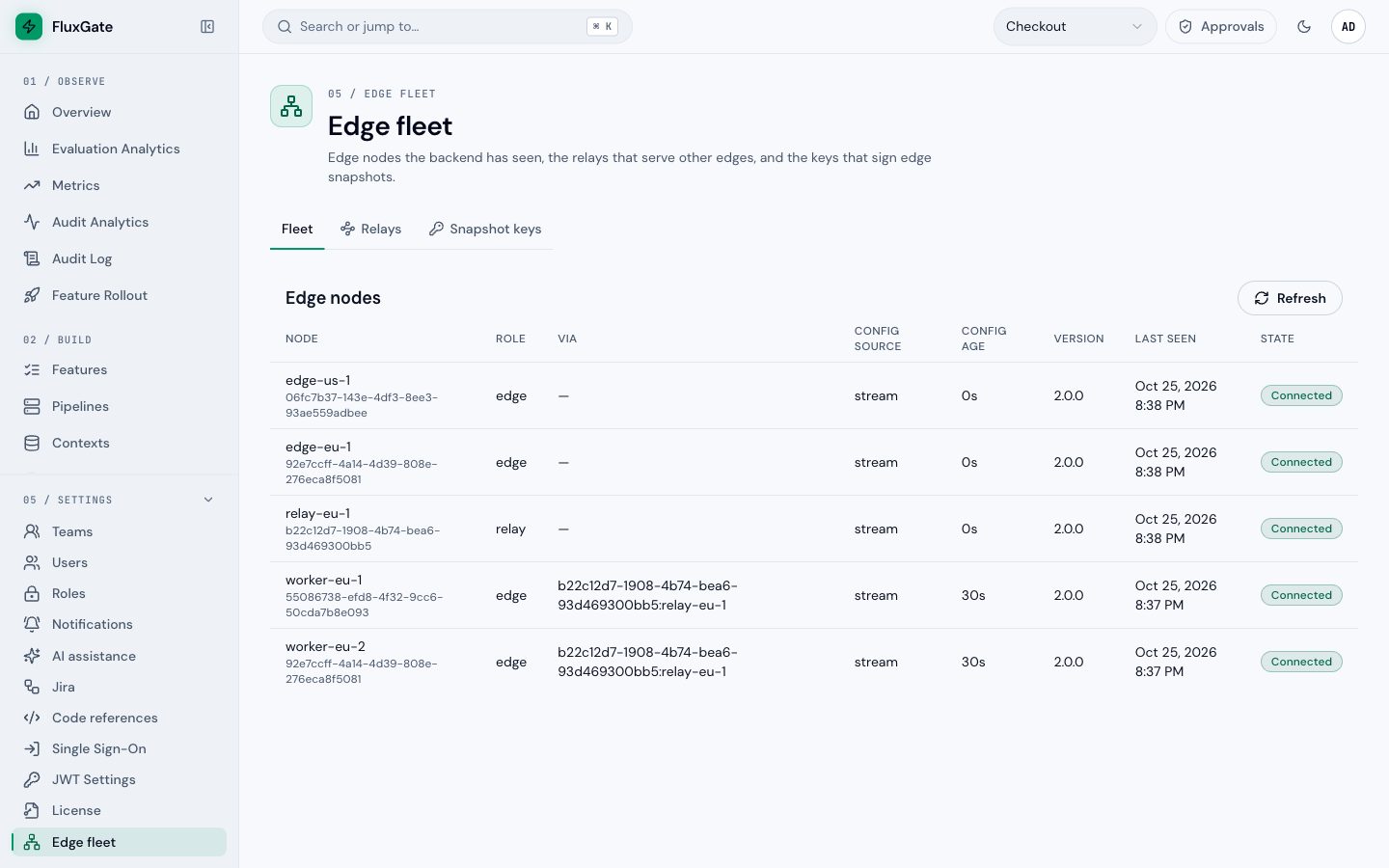 (opens full size in a new tab)
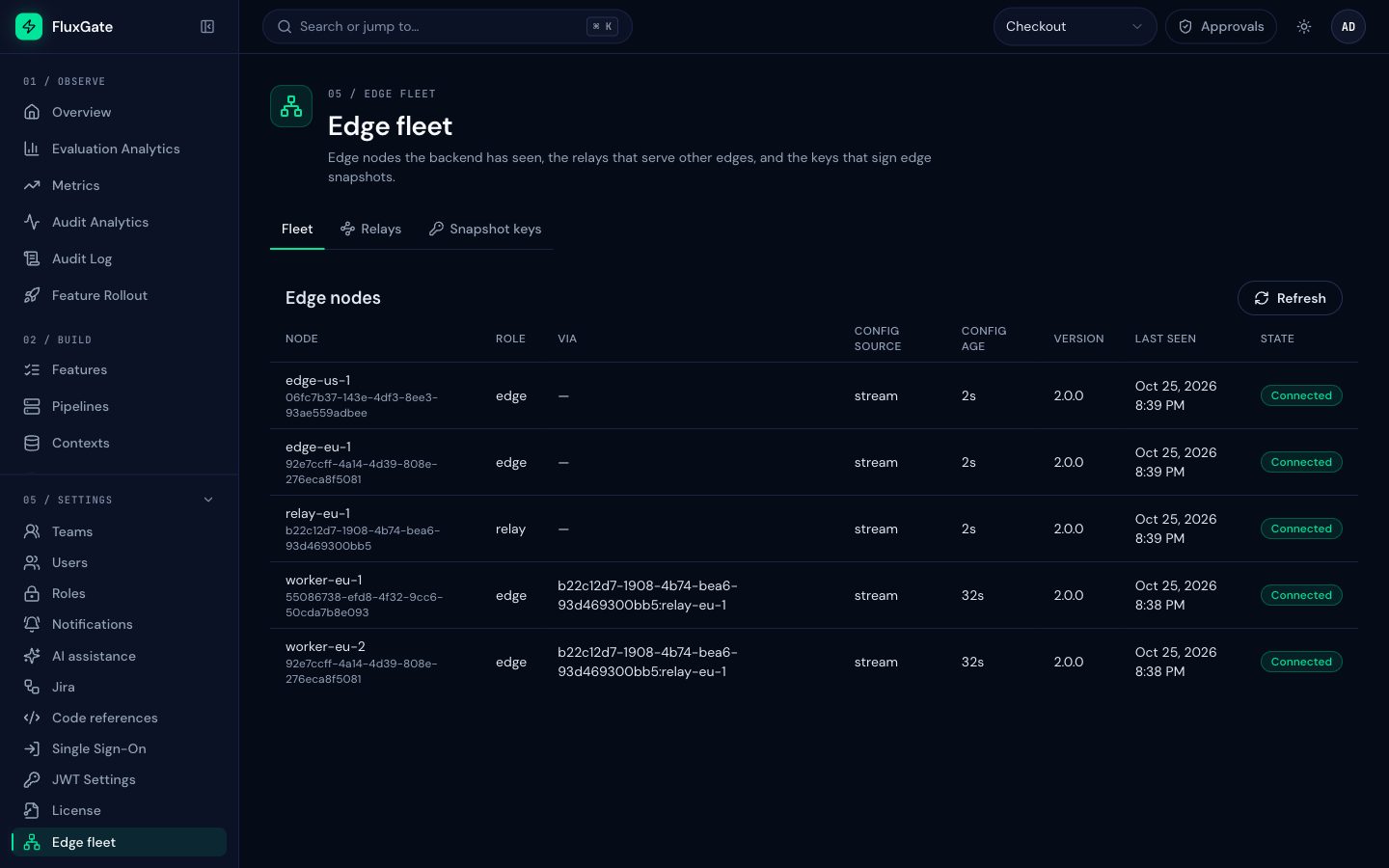 (opens full size in a new tab)
The fleet view needs the backend, so use it before and after an outage, not during one. The same list is at GET /api/v1/edge/fleet.
Backend outage runbook
Check
GET /health/detailon a few edges:streamConnected,configSource,configAgeSecs,lastSyncedAt,queues.- The response headers on any evaluation:
FluxGate-Config-SourceandFluxGate-Config-Age. /metrics:fluxgate_edge_upstream_connectedis0andfluxgate_edge_config_age_secondsgrows.- Relays: the
relayblock of/health/detail, andfluxgate_edge_relay_children. - Edge logs:
Failed to connect to backend gRPC,Ignoring bootstrap snapshot ..., and the singleerrorline when a local file is unusable.
Act
- An edge is not ready after a restart. It has no usable local file. Put a fresh signed export at its
bootstraplocation. The edge retries after 5, 10, 20 and 40 seconds, then every 60 seconds, and applies the file without a restart. - A security incident during the outage. You cannot revoke a client on the edges while the backend is down. Block the client at the network layer, and revoke it when the backend is back.
- Old flags must not be served. Set
resilience.ready_max_age_secsbefore the next outage, so a load balancer drops edges whose flags are older than you accept. The default0keeps them in. - Do not change flags and expect them to arrive. Nothing reaches the edges until the backend is back, and kill switches cannot fire.
Recover
When the backend is back, each edge's stream delivers a complete snapshot. The source becomes stream, the age returns to 0, flags the backend no longer has are removed, and queued events flush. Check the fleet view: every edge should show stream and an age near 0 within a minute.
Run an outage drill
Run this once per environment, and again after you change a topology:
- Start an edge with
snapshot.dirwhile the backend is up. Wait for"configSource": "stream". - Stop the backend. Evaluate a flag: it still answers, and
FluxGate-Config-Agegrows. - Restart the edge. It is ready again with
"configSource": "local". - For bootstrap: delete the
.fgsfile, restart the edge, and check"configSource": "bootstrap". - Start the backend. Check that the source returns to
streamand the age to0.
Next
Read the configuration reference for every edge setting and the Edge server API for the full health and metrics fields.